Helpful updates, enrollment reminders, and plain-language explanations to help you make informed Medicare decisions.
Latest information
What Medicare beneficiaries should know
Prescription drug plans
Have a Medicare Supplement Plan? Learn How to Compare and Enroll in a Medicare Drug Plan for 2027
If you have Original Medicare with a Medicare Supplement (Medigap) plan, prescription drug coverage is generally purchased separately through a stand-alone Medicare Part D plan. It is a good idea to review your drug coverage each year because plan premiums, covered medicines, pharmacy networks, and cost-sharing can change.
Medicare’s Annual Enrollment Period runs from October 15 through December 7, 2026. Changes made during this period generally begin January 1, 2027. You can compare plans and submit an enrollment request online at Medicare.gov.
How to compare and enroll in a Medicare drug plan
Gather your information. Make a current list of every prescription you take, including the exact name, strength, and how often you take it. Also note your ZIP code, preferred pharmacies, Medicare number, and current drug plan details if you have them.
Visit Medicare.gov. Go to the Medicare Plan Finder. Choose the option to review or compare drug plans for 2027. You can sign in or continue without signing in.
Note: When prompted, click on 2027, enter your ZIP code, and click the “Continue” button.
Enter your prescriptions and pharmacies. Add each medicine and select the pharmacies you would consider using. Check the spelling, dosage, and quantity so the comparison reflects your actual prescriptions. You can compare plans using a retail pharmacy or mail order when those options are available.
Watch: How to Compare Medicare Drug Plans and Enroll Online
Compare the plans that appear. Review the estimated yearly cost, which can include premiums and estimated prescription costs. Check whether each medicine is covered, its tier and cost, the plan’s deductible, pharmacy options, and any coverage rules such as prior authorization or quantity limits. For 2027, a plan’s deductible can be as high as $700, though some plans have a lower deductible or none. Covered Part D drug out-of-pocket costs are capped at $2,400 for the year.
Choose the plan that fits your needs. Consider both your expected costs and how convenient it will be to fill your prescriptions. A plan with a low premium may not have the lowest total cost for your medicines.
Enroll and save your confirmation. Follow Medicare.gov’s instructions to submit the enrollment request. Review the information before submitting, then save or print the confirmation number and any plan details provided.
After you enroll
Watch for a confirmation from the plan and check that the coverage will begin January 1, 2027. Keep your confirmation and plan information with your Medicare records. If you do not receive confirmation or have questions about the enrollment, contact Medicare at 1-800-MEDICARE or the plan you selected.
Final reminder: Review the plan’s details using your own prescriptions and preferred pharmacies before enrolling. For official plan comparisons, visit the Medicare Plan Finder.
Comparing coverage
Medicare Supplement vs. Medicare Advantage plans
By Sean A. Renfroe, licensed independent insurance broker
When someone becomes eligible for Medicare, one of the biggest decisions is how they want to receive their coverage.
Two popular choices are Original Medicare paired with a Medicare Supplement plan, or a Medicare Advantage plan. Both can provide valuable coverage, but they work very differently.
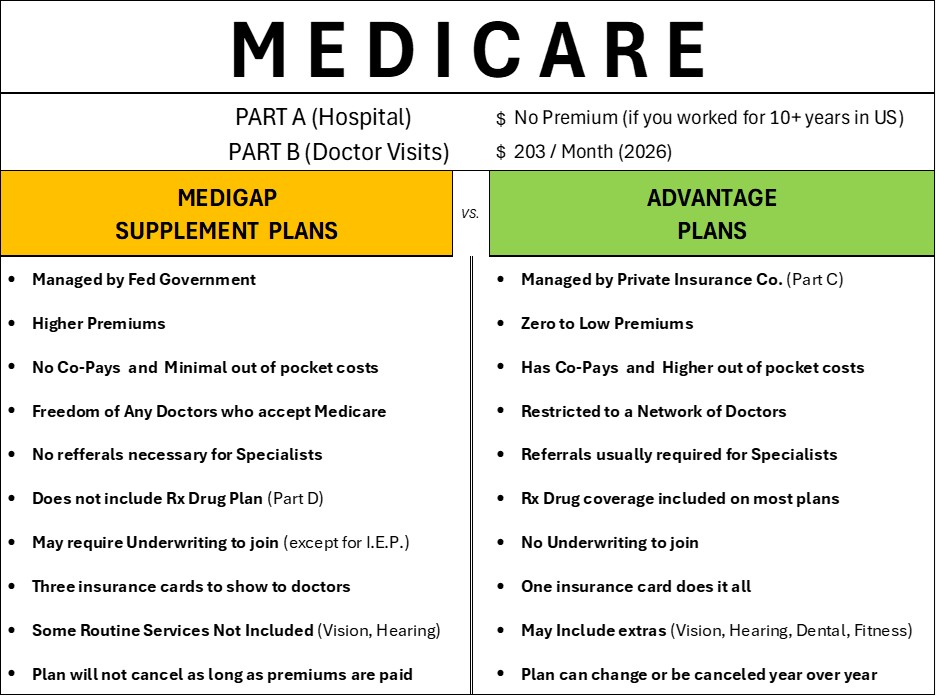
This graphic provides a broad overview. Specific premiums, copayments, networks, referrals, and benefits vary by plan and location.
Medicare Supplement plans
Medicare Supplement plans—also called Medigap plans—work alongside Original Medicare. Original Medicare pays its portion of approved medical expenses, and the Supplement plan helps cover certain remaining costs, depending on the plan selected.
Some important features include:
The freedom to use any doctor or hospital in the United States that accepts Medicare
Generally no provider networks
Usually no referrals needed to see specialists
More predictable medical expenses, although premiums are generally higher
A separate Part D plan is needed to have prescription-drug coverage
Medical underwriting may be required if you apply outside certain protected enrollment periods
Medigap policies are sold by private insurance companies, even though the primary coverage comes through federally administered Original Medicare.
Medicare Advantage plans
Medicare Advantage plans—also called Part C—are offered by private insurance companies approved by Medicare. They provide your Part A and Part B benefits through the plan instead of through Original Medicare.
Some important features include:
Many plans have a low or $0 additional monthly premium, although you must continue paying your Part B premium
Most plans include prescription-drug coverage
Plans may offer additional benefits such as routine dental, vision, hearing, or fitness benefits
Copayments and other out-of-pocket expenses commonly apply when services are received
Provider networks may apply, particularly with HMO plans
Referrals and prior authorization may be required for certain services
Benefits, costs, provider networks, and plan availability can change from year to year
Medicare Advantage plans include an annual limit on what members pay out of pocket for covered Part A and Part B services. Original Medicare does not have this type of annual limit unless someone has supplemental coverage or other insurance.
Which option is better?
Neither option is automatically best for everyone.
A Medicare Supplement plan may appeal to someone who values broad access to Medicare-participating providers and more predictable medical expenses.
A Medicare Advantage plan may appeal to someone who prefers lower monthly premiums, bundled prescription coverage, and possible extra benefits—and who is comfortable reviewing provider networks and cost-sharing requirements.
The right choice depends on your doctors and preferred hospitals, prescription medications, travel habits, monthly budget, expected healthcare needs, and comfort with networks and medical copayments.
If you would like help comparing the Medicare options available in your area, I’ll be glad to explain them in clear, simple terms.
Avoid costly penalties
One of the biggest Medicare mistakes seniors should avoid
By Sean A. Renfroe, licensed independent insurance broker
As a licensed Medicare broker, there is one major mistake I think seniors should avoid. This is one of the biggest mistakes a person on Medicare can make, and it can be very costly.
It’s when a senior wrongly delays Medicare because they’re self-employed, they’re on COBRA, or they have an individual health insurance plan—maybe through the Marketplace.
Even if you have health insurance, that does not always mean you can delay Medicare at age 65. You need to make sure your coverage qualifies under Medicare’s rules.
COBRA doesn’t count as coverage based on current employment for the Part B Special Enrollment Period. If you’re self-employed with your own individual health insurance, that may not count either. Marketplace coverage also does not create a Part B Special Enrollment Period.
You may still need to enroll in Medicare at age 65, or you could face Medicare Part B and Part D late-enrollment penalties. Those penalties can last for as long as you have that coverage, and they can increase the longer you wait.
So, you’ve got to check and make sure your coverage meets Medicare’s requirements before you think about delaying Medicare. For Part B, ask whether it is employer group health plan coverage based on current employment. For Part D, ask whether your prescription drug coverage is considered creditable coverage.
Medicare has several enrollment periods, and each one serves a different purpose. Some are for signing up for Medicare for the first time, while others let you review or change Medicare Advantage and prescription drug coverage.
Knowing which enrollment period applies can help you make changes at the right time.
The main Medicare enrollment periods
Initial Enrollment Period: Your first opportunity to enroll generally lasts seven months—starting three months before the month you turn 65 and ending three months afterward.
Annual Enrollment Period: From October 15 through December 7, people can make certain changes to Medicare Advantage and Part D prescription drug coverage for the following year.
Medicare Advantage Open Enrollment Period: From January 1 through March 31, people already enrolled in Medicare Advantage can make one change to another Medicare Advantage plan or return to Original Medicare. Those returning to Original Medicare may also join a separate Part D plan.
General Enrollment Period: From January 1 through March 31, this provides another opportunity to enroll in Medicare Part A and/or Part B if you missed your first opportunity and do not qualify for a Special Enrollment Period. Late-enrollment penalties may apply.
Special Enrollment Periods: Certain life events—such as moving, losing other coverage, or changes involving Medicaid or Extra Help—may create a separate opportunity to enroll or change coverage. The timing and choices depend on the situation.
The next major opportunity: Annual Enrollment
This year’s Medicare Annual Enrollment Period runs from October 15 through December 7, 2026. Changes made during this period generally take effect January 1, 2027.
During Annual Enrollment, depending on your current coverage, you may be able to:
Switch from one Medicare Advantage plan to another
Move from Original Medicare to Medicare Advantage
Leave Medicare Advantage and return to Original Medicare
Join, drop, or switch a Medicare Part D prescription drug plan
What should you review before October 15?
Start with your doctors, hospitals, prescriptions, preferred pharmacies, expected healthcare needs, and budget. Compare more than the monthly premium: provider networks, drug formularies, copayments, deductibles, prior-authorization rules, and the plan’s yearly out-of-pocket limit can all matter.
Your plan’s Annual Notice of Change can help identify what will be different next year, but it is only one part of a complete review. You can also read the official Medicare Open Enrollment information at Medicare.gov.
Enrollment reminder
Get ready before Medicare Annual Enrollment begins
Medicare Annual Enrollment runs from October 15 through December 7 each year. It is a good time to review whether your current coverage will still fit your needs for the coming year.
Your Notice of Change deserves a careful review.
Before comparing your options, gather:
Your current plan information and Annual Notice of Change
An up-to-date list of prescriptions, dosages, and preferred pharmacies
The names of doctors, specialists, and hospitals you want to keep
Questions about premiums, copays, travel, dental, vision, or hearing benefits
Even if you like your current plan, costs, benefits, provider networks, and drug coverage can change from one year to the next.
This information is for general educational purposes and is not a complete description of benefits. Plan availability, benefits, provider networks, drug coverage, and costs vary by location and may change each year.
Questions are welcome
Want help reviewing your Medicare options before AEP?
Sean can help you compare the details and understand which choices deserve a closer look.